






- Navigation -
 Current Location:
NEWS DETAILS
NEWS INFORMATION
Modular Welding Tables: Optimizing Fabrication Workflow for Maximum Throughput
AUTHOR:Bozhong Tool DATE:2026-06-29 21:26:31 HITS:69
Fabrication shops are under constant pressure to do more with less: more orders, faster deliveries, tighter tolerances, and narrower margins. In this environment, the welding workstation is often the bottleneck that determines whether a factory meets its production targets or falls behind schedule. Modular welding tables offer a practical, proven solution to this challenge, transforming the way factories approach setup, execution, and changeover on the welding floor with measurable improvements in operational efficiency.
The Setup Time Problem
In many fabrication shops, setup time consumes a disproportionate share of total production time each day. When an operator receives a new part to weld, they must position the workpiece, align it to specifications, secure it with clamps, and verify that everything is square and level before striking the first arc. On complex weldments, this setup process can take an hour or more of valuable production time. Multiply this by multiple shifts and multiple workstations, and the cumulative cost of setup becomes enormous, directly impacting the factory ability to meet delivery commitments and maintain competitive pricing.
Traditional approaches to reducing setup time rely on dedicated fixtures for each product. While effective for high-volume, stable-product lines, this approach becomes economically unviable when product variety is high or design changes are frequent. This is precisely where modular tables demonstrate their full value, delivering rapid changeover capabilities without the capital commitment and lead time associated with custom fixture development.
How Modular Design Changes the Equation
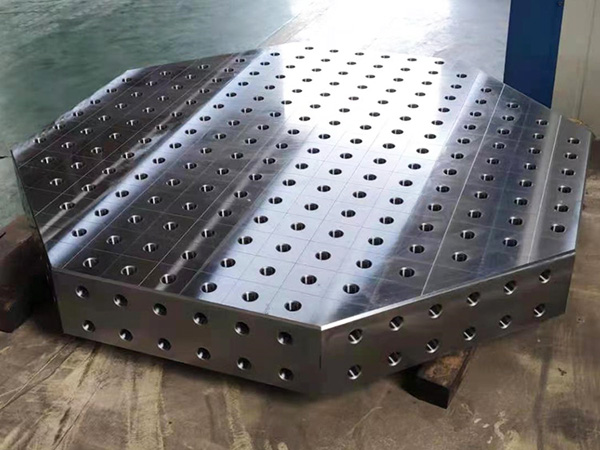
Modular welding tables use a standardized grid of holes and a range of compatible accessories that can be reconfigured for any workpiece geometry. Instead of building a new fixture for each part, operators select from a library of standardized components - stop pins, angle plates, risers, and clamps - that interlock with the table hole pattern to create a custom setup in minutes rather than hours, dramatically reducing the non-value-added time in each production cycle.
This approach dramatically compresses the setup time curve and improves production flexibility. The same table that is configured for a large structural frame today can be completely reconfigured for a small subassembly tomorrow, without any loss of accuracy or repeatability. The standardized components ensure that setups are consistent regardless of which operator performs the configuration, reducing variability and improving quality across the entire workforce.
Reducing Workstation Inventory Requirements
Another significant benefit of modular tables is the reduction in dedicated workstations required to run an efficient fabrication shop. Traditionally, a factory might need a separate station for each major product line or product family, tying up substantial floor space and capital in equipment that sits idle when production switches to other product families.
With modular tables, a single versatile workstation can handle multiple product types, reducing the capital investment in equipment and the floor space required to house it. This consolidation also simplifies inventory management and maintenance significantly. Instead of tracking the condition and location of dozens of specialized fixtures, a factory manages a smaller inventory of modular components that can be used across all products. When a component wears out, it is replaced individually rather than requiring a complete fixture overhaul.
Improving Operator Efficiency and Satisfaction
Modular tables do more than improve throughput numbers - they also make operators jobs more satisfying and engaging. Skilled welders often spend more time setting up workpieces than actually welding, which is frustrating for experienced craftspeople who want to apply their skills to producing quality welds rather than wrestling with fixtures.
The ability to visualize a layout on a modular table before committing to welding also improves first-pass quality outcomes. Operators can see the entire weld sequence, identify potential interference issues, and adjust the setup proactively rather than discovering problems after the first weld has been laid down, which would require cutting and re-welding to correct the error.
Implementation Strategies for Factories
Introducing modular welding tables into a fabrication environment requires some upfront planning and commitment from management. Factories should assess their product range to determine which table sizes and accessory kits will cover the majority of their production needs with the greatest efficiency benefit.
It is worth investing in a comprehensive starter kit of accessories - the ability to handle a wide variety of setups from day one accelerates the return on investment significantly and allows the factory to experience the full benefits of modular working immediately. Training is also important for achieving the full potential of the system. Operators who understand the principles behind modular setup techniques will get far more value from the system than those who simply use it as a slightly more convenient flat table.
References:
American Welding Society (AWS). Standard Welding Terms and Definitions. AWS A3.0, current edition.
ISO 6943:2015. Welding - Fatigue test for welded joints. International Organization for Standardization.
ASM International. Welding Fundamentals and Processes. ASM Handbook Vol. 6A, 2011.
ESAB. The Fabricator's Guide to Welding Table Selection. ESAB Technical Publications, 2020.
Kalpakjian, S. and Schmid, S. Manufacturing Engineering and Technology. Pearson, 7th edition, 2013.
-
Welding Table Surface Hardness — What Rockwell and Brinell Numbers Mean for Buyers
-
Welding Table Load Capacity — Understanding Static and Dynamic Ratings
-
Modular Welding Table ROI — Calculating Return on Investment for Fabrication Shops
-
Industrial Metrology Basics for Welding Fabrication — Standards, Tools, and Workflows
-
Granite Surface Plate Calibration — Frequency, Methods, and Standards
-
How to Design a Welding Fixture from Scratch — A Step-by-Step Engineering Guide
Botou Bozhong Precision Machine Tool Co., Ltd.
Copyright © 2025-2026 https://www.bozhong-weldingtable.com. All Rights Reserved Botou Bozhong Precision Machine Tool Co., Ltd.Copyright