






- Navigation -
 Current Location:
NEWS DETAILS
NEWS INFORMATION
D16 Welding Table Hole System: A Complete Buyer's Guide for Fabrication Shops
AUTHOR:Bozhong Tool DATE:2026-10-05 10:19:53 HITS:132
Choosing a D16 welding table is rarely a purchase about steel plate. It is a decision about how fast your shop can go from a drawing to a clamped, repeatable weldment — and how often that setup has to be rebuilt from scratch. For job shops, prototype cells and small-batch fabricators, the hole-system workbench has quietly become the most flexible fixture investment available, because it replaces dozens of dedicated jigs with one grid and a growing library of reusable clamps.
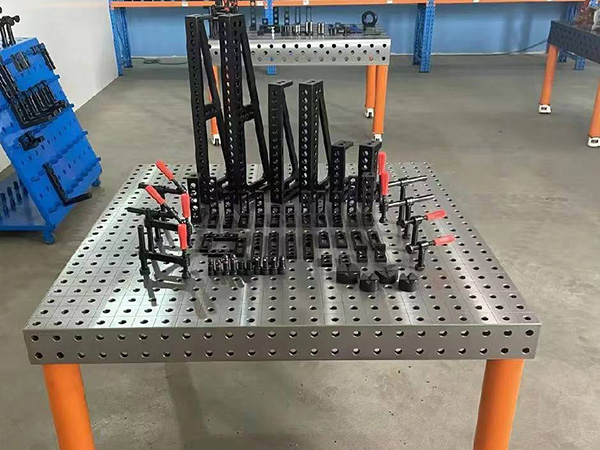
This guide breaks down what the D16 designation actually covers, why hole geometry matters more than plate thickness, how to read hardness and flatness numbers on a supplier datasheet, and what to put into a purchase specification so that the table you receive behaves the way your fixtures expect it to.
1. What 'D16' Actually Means on a Welding Table
The D16 label refers to the hole system, not to a particular size of table. In a D16 system the work surface is drilled with a grid of precision holes of 16 mm nominal diameter, and every clamp, stop, angle bracket and locating pin in the system indexes into those holes. Because the hole diameter and the grid pitch are standardized, a fixture bought this year still fits a table bought five years from now — which is the whole point of a modular system.
Two numbers define a D16 system, and buyers frequently quote only one of them:
Hole diameter (16 mm): determines which clamping bushings, pins and bolts can be used. Undersized holes cause bushings to seat loosely; oversized holes let a clamp rock under load.
Grid pitch (the centre-to-centre distance): determines the resolution of your fixturing. A finer pitch means a stop can be placed closer to the ideal position; a coarser pitch is cheaper to manufacture and leaves more material between holes.
Hole tolerance and surface finish: determines whether a locating pin drops in by hand or has to be tapped. Precision-bored holes hold their geometry far longer in a shop where spatter and impact are daily events.
Plate thickness and ribbing: determines stiffness under load, and therefore how much the surface deflects when a heavy assembly is clamped down.
When you compare quotations, compare all four. A thicker top with loose hole tolerance will frustrate your welders more than a thinner top with tight, clean bores.
2. Why Hole Geometry Matters More Than Plate Thickness
There is a persistent belief that heavier is always better. In practice, most fixturing errors on a modular table are not caused by the plate bending; they are caused by the clamp moving in the hole. A 0.2 mm of play at the bushing becomes 2 mm of error at the end of a 500 mm arm. That is the difference between a part that fits the assembly and a part that gets reworked.
So the questions worth asking a supplier are about the hole, not the mass:
Is the hole bored or simply punched/drilled? Boring delivers better roundness and a smoother wall.
What is the positional tolerance of the grid across the full table, and is it verified after machining?
Are the holes chamfered or countersunk so that spatter and dirt do not prevent a bushing from seating?
Is there a protection scheme (plugs, caps, or sacrificial bushes) for the holes that are not in use?
3. Material and Heat Treatment: Low-Alloy Steel vs. Mild Steel
The D16 welding table produced by Botou Bozhong is built from D16 low-alloy steel. Low-alloy steel is chosen over plain carbon plate for three practical reasons: it responds predictably to heat treatment, it holds a harder, more wear-resistant surface after treatment, and it resists the localized softening that repeated weld heat can cause in cheaper plate.
For the buyer, the benefit shows up in the maintenance calendar rather than on day one. A softer table top develops dents, spatter adhesion and raised burrs around the holes; raised burrs are the classic reason clamps stop seating properly. A surface that resists impact keeps its geometry, which keeps your fixture library accurate.
4. Flatness, Surface Hardness, and What to Write Into the Purchase Spec
Two measurable properties decide whether a D16 table is fit for precision work: surface flatness and surface hardness. Hardness is commonly reported in Brinell (HB) and sometimes Rockwell (HRC) on supplier datasheets. Values in the region of HB 170–220 are typical for a work-hardened low-alloy welding table top: hard enough to resist dents and spatter bonding, soft enough that the surface can still be re-machined or dressed without cracking.
| Property | What to ask for | Why it matters in the shop |
|---|---|---|
| Hole diameter | 16 mm system, bored to tolerance | Decides which clamps fit and how tightly they seat |
| Grid pitch | Stated and consistent over full surface | Controls fixturing resolution and repeatability |
| Surface hardness | Typically HB 170–220 for low-alloy tops | Resists dents, spatter bonding and burr formation |
| Flatness | Grade stated over full working area | Directly sets the accuracy of the welded assembly |
| Load rating | Static and dynamic figures separately | Prevents deflection surprises on heavy weldments |
| Surface finish | Ground finish, chamfered holes | Spatter releases more easily, cleaning is faster |
Notice that hardness and flatness pull in opposite directions. Chasing maximum hardness makes the top brittle and difficult to recondition; chasing maximum flatness on a soft top means the flatness will not survive a year of production. The sensible target is a balanced specification, which is exactly what a hardened-but-machinable low-alloy top is designed to deliver.
5. Building a Fixture Library Around the D16 System
A D16 welding table delivers its return through the accessories that live with it. The most effective libraries are not the biggest ones; they are the ones standardised around a short list of parts that the team uses every day. A practical starting kit looks like this:
Locating stops and stop rails — the parts that define datums; buy more of these than you think you need.
Quick-locking clamps in two or three sizes — the single biggest time saver in the system.
Angle brackets and right-angle plates — for boxing square frames without measuring each corner.
Locating pins and bushings — consumable wear items; keep spares on the shelf.
Support and riser blocks — to bring odd-shaped work up to a convenient welding height.
Hole plugs and cleaning tools — cheap, and the reason tables stay accurate for years.
Once the kit is defined, photograph and document each common setup. The moment a recurring job has a recorded fixture layout, setup time collapses — and that is where the return on a modular welding table actually comes from.
6. Maintenance: Keeping a D16 Table Accurate for Years
Modular tables fail slowly, through neglect rather than catastrophe. A short routine prevents almost all of it:
Brush the surface and blow out unused holes at the end of every shift.
Never grind or arc-gouge directly on the working surface; use a sacrificial sheet.
Dress raised burrs around hole edges immediately — before a clamp stops seating.
Re-check flatness on a schedule appropriate to your workload, and after any major impact event.
Store clamps and pins off the table so that dropped tools are not the cause of the next dent.
FAQ: D16 Welding Tables
Is a D16 system accurate enough for production welding?
For the large majority of fabrication work — frames, brackets, enclosures, assemblies with tolerances in the tenths of a millimetre — yes. The limiting factor is almost never the hole system itself; it is whether the fixture library is complete and whether the clamps are in good condition.
When should I choose D28 instead of D16?
Move up to a D28 hole system when the clamp loads and workpiece mass increase substantially: large weldments, heavy sections, and repeated high-force clamping. The larger bore accepts heavier-duty clamping elements. See our dedicated comparison of the two systems for the full decision table.
Can tables be spliced into a larger working surface?
Yes. Spliced configurations are common for long frames and large weldments, and they are one of the reasons modular platforms scale so well. The joint line must be aligned and the combined surface verified, which is why on-site installation, scraping and lapping services matter when you buy a multi-section table.
What information should I send with an enquiry?
Workpiece dimensions and weight, the material you weld, your tolerance targets, the number of repeats per month, and photos or drawings of a typical assembly. With that, a supplier can specify hole pattern, plate thickness, support legs and a starter fixture kit instead of quoting a generic table.
Botou Bozhong Precision Machine Tool Co., Ltd. has manufactured welding platforms, cast iron plates, granite measuring tools and machine tool castings since 1976, and supports buyers with on-site installation, debugging, scraping and lapping. Drawings, workpiece dimensions and tolerance targets are all our engineers need to recommend a hole system, a plate specification and a starter fixture kit.
-
D16 Welding Table Hole System: A Complete Buyer's Guide for Fabrication Shops
-
Welding Table Surface Hardness — What Rockwell and Brinell Numbers Mean for Buyers
-
Welding Table Load Capacity — Understanding Static and Dynamic Ratings
-
Modular Welding Table ROI — Calculating Return on Investment for Fabrication Shops
-
Industrial Metrology Basics for Welding Fabrication — Standards, Tools, and Workflows
-
Granite Surface Plate Calibration — Frequency, Methods, and Standards
Botou Bozhong Precision Machine Tool Co., Ltd.
Copyright © 2025-2026 https://www.bozhong-weldingtable.com. All Rights Reserved Botou Bozhong Precision Machine Tool Co., Ltd.Copyright