






- Navigation -
 Current Location:
NEWS DETAILS
NEWS INFORMATION
Magnesium-Aluminum Straightedge vs Cast Iron Straightedge: Choosing the Right Straight Reference
AUTHOR:Bozhong Tool DATE:2026-10-28 10:47:54 HITS:124
A straightedge is the simplest precision instrument in the workshop: a long, accurate straight reference used with a feeler gauge or a light source to check whether a surface is flat or straight. The material it is made from, however, decides whether that check is easy or awkward, and whether the instrument is still true after a year of being carried around a shop.
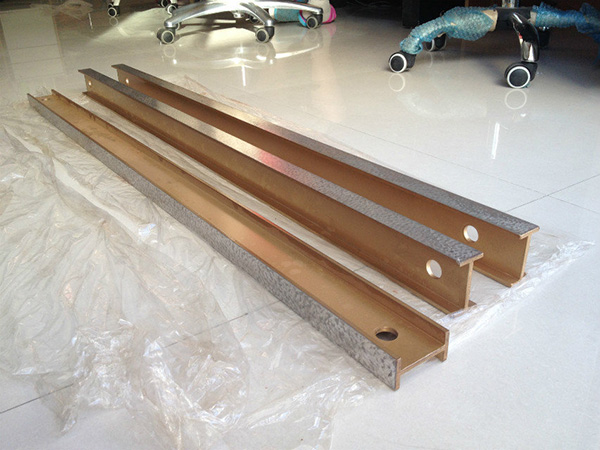
This comparison sets out the practical differences between the magnesium-aluminum straightedge and the traditional cast iron straight edge, and finishes with a selection guide based on length, working environment and inspection duty.
1. What Each Material Offers
| Property | Magnesium-aluminum alloy straightedge | Cast iron straight edge |
|---|---|---|
| Weight | Roughly a third the weight of cast iron | Heavy, especially in long lengths |
| Handling | Easy for one person, even at 2–3 m | Often needs two people or a crane at length |
| Stiffness-to-weight | Good; but lower modulus means more deflection at equal section | High; very stiff in a properly ribbed section |
| Wear resistance | Softer working edge; dents and scratches more easily | Hard, wear-resistant edge; holds geometry well |
| Corrosion | Resists rust; can oxidise if unprotected | Rusts; needs care in humid shops |
| Thermal response | Higher expansion than iron; more sensitive to temperature change | Lower expansion; slower, more stable response |
| Reconditioning | Usually replaced rather than re-finished | Can be re-scraped or re-machined |
2. Weight and Handling: The Decisive Factor at Length
For short straightedges, material hardly matters. For long ones, it dominates. A cast iron straightedge in the two-to-three-metre range is difficult to position, difficult to hold steady, and genuinely hazardous to lift repeatedly — and an instrument that is awkward to use tends not to be used.
Under roughly 1 m: either material; choose on cost, feel and availability.
1–2 m: magnesium-aluminum becomes clearly easier for routine checks by one operator.
Above 2 m: the weight argument usually decides it, provided the required accuracy is compatible with the alloy's stiffness.
3. Stiffness, Deflection and the Correct Way to Support
The one genuine engineering caution with light-alloy straightedges is deflection. A straightedge supported at the wrong points will sag, and the sag is read as an error in the surface being checked.
Support at the designated points — typically at the Airy points for long instruments — so that the working edge is as straight as it can be.
Do not support at the extreme ends for long lengths; this is the most common cause of a false reading.
Lift and turn the straightedge rather than dragging it across the surface.
Allow the instrument to reach workshop temperature before use.
Verify periodically, especially after any drop or bend.
4. Wear, Damage and Working Life
Cast iron wins on durability. Its working edge resists abrasion, tolerates contact with rough castings and can be re-finished when it eventually wears or is damaged. Light-alloy straightedges are kinder to the operator but less forgiving of abuse: a knock bends or dents the edge, and re-finishing is usually uneconomic.
Rough shop-floor use: cast iron.
Frequent carrying and positioning: magnesium-aluminum.
Inspection rooms and clean environments: either; granite parallel straightedges are also used where corrosion resistance and stability are priorities.
Environments where the tool will be knocked about: cast iron, without question.
5. Thermal Behaviour and Accuracy
Aluminium alloys expand roughly twice as much as cast iron for the same temperature change. In a climate-controlled inspection room that is irrelevant; in a shop where the temperature swings, or where the straightedge has been lying in sunlight or next to a furnace, it matters.
Allow the instrument to stabilise to workshop temperature before precision checks.
Avoid leaving it on or near hot machines, in direct sunlight, or against a cold external wall.
State the reference temperature when specifying straightness tolerance.
For the tightest work in uncontrolled environments, cast iron or granite is the safer choice.
6. Selection Guide
| Situation | Recommended straightedge |
|---|---|
| Long machine beds and large weldments, checked often | Magnesium-aluminum, for handling |
| Rough foundry or fabrication environment | Cast iron, for durability |
| Inspection room with temperature control | Either; consider granite parallel straightedges |
| Tight straightness tolerance in uncontrolled temperature | Cast iron or granite |
| Frequent transport between sites | Magnesium-aluminum |
| Existing instruments are re-finished in house | Cast iron |
FAQ: Straightedges
Does a lighter straightedge give less accurate results?
Not inherently, provided it is supported correctly and used within its design. The risk is deflection from incorrect support or careless handling, not the material itself.
How often should a straightedge be verified?
Annually in normal use, and immediately after any drop, bend or suspected damage. Instruments used for tight straightness checks or carried frequently should be verified more often.
Can a damaged straightedge be repaired?
Cast iron can usually be re-scraped or re-machined and re-verified. Light-alloy straightedges that are bent or deeply dented are generally replaced, which is the main life-cycle cost difference between the two.
Working lengths, tolerance requirements, shop temperature range and how often the instrument will be handled are enough for the engineering team to recommend material, section and accuracy grade.
-
Magnesium-Aluminum Straightedge vs Cast Iron Straightedge: Choosing the Right Straight Reference
-
Granite Surface Plate vs Cast Iron Surface Plate: Which Measuring Base Should You Specify?
-
Cast Iron Surface Plate Grades and Accuracy: How to Specify What You Actually Need
-
Machine Tool Leveling Pads and Adjustment Shims: A Practical Installation Guide
-
Sand Casting Parts for Machine Tools: From Pattern to Finished Casting
-
Sand Casting Parts for Machine Tools: From Pattern to Finished Casting
Botou Bozhong Precision Machine Tool Co., Ltd.
Copyright © 2025-2026 https://www.bozhong-weldingtable.com. All Rights Reserved Botou Bozhong Precision Machine Tool Co., Ltd.Copyright