






- Navigation -
 Current Location:
NEWS DETAILS
NEWS INFORMATION
Sand Casting Parts for Machine Tools: From Pattern to Finished Casting
AUTHOR:Bozhong Tool DATE:2026-10-12 16:18:31 HITS:64
Almost every structural part of a machine tool — the bed, the column, the crossbeam, the worktable, the headstock — starts life as a sand casting. The process has not really changed in principle for a century: a pattern forms a cavity in bonded sand, molten iron fills it, and the solidified shape is cleaned, heat-treated and machined. What has changed is the control around each step, and that control is what separates a casting that machines beautifully from one that scraps at the first cut.
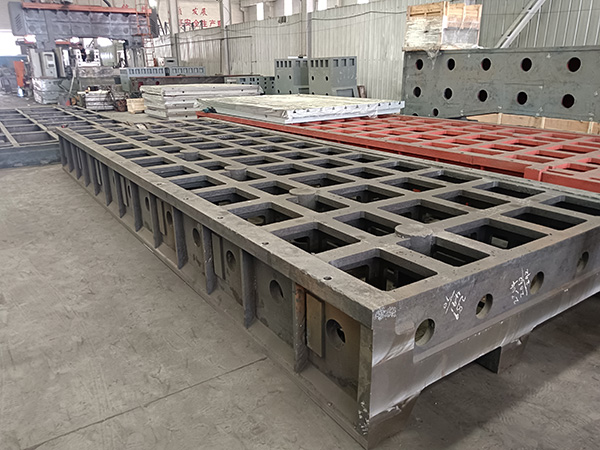
This article walks through the full route from drawing to finished casting, and translates each step into what a buyer should specify and verify.
1. The Route From Drawing to Casting
| Stage | What happens | What the buyer should specify or check |
|---|---|---|
| Drawing review | Foundry checks castability, sections, datums | Machining allowance, datum scheme, critical areas |
| Pattern and core boxes | Tooling built to the drawing with shrinkage allowance | Tooling material, expected life, who owns the tooling |
| Moulding and coremaking | Sand prepared, moulds and cores assembled | Sand process, core support, dimensional control |
| Melting and pouring | Composition and temperature controlled, metal poured | Material grade, charge control, pouring records |
| Cooling and shakeout | Casting cooled, removed from the mould | Cooling practice, which affects internal stress |
| Cleaning and fettling | Gates, risers and fins removed; shot blasting | Surface condition, repair weld policy |
| Heat treatment | Stress relieving or ageing applied | Treatment record and temperature chart |
| Rough machining | Datum faces and critical surfaces cut | Allowance left for finish machining |
| Inspection | Dimensional, NDT and hardness checks | Acceptance criteria and documentation |
2. Patterns, Tooling and Shrinkage
The pattern is not a copy of the finished part. It carries shrinkage allowance, draft, machining allowance and core prints. Getting this tooling right is the single largest determinant of dimensional consistency across a production run.
Shrinkage allowance: differs by material and section; an experienced foundry sets it by grade and geometry, not by rule of thumb.
Draft: required so the pattern can be withdrawn without damaging the mould.
Core prints: define how internal cavities are formed and how cores are supported.
Tooling ownership and life: clarify who owns the pattern, how it is stored, and how many pours it is expected to survive.
3. Sand, Moulds and Dimensional Control
Moulding sand is a controlled engineering material, not just dirt. Properties such as strength, permeability and moisture content are monitored because they control surface finish, gas defects and dimensional accuracy. Cores are equally critical: a core that shifts by two millimetres produces a wall thickness that is wrong in a place that may not be discovered until machining.
4. Casting Defects That Matter to Machine Tools
Not every indication is a defect, and not every defect is fatal. The defects that matter most in machine tool castings are the ones located in loaded or machined areas:
Shrinkage porosity: in thick sections and hot spots; reduces strength and can open up as a cavity during machining.
Inclusions and slag: cause tool damage and poor surface finish on machined faces.
Blowholes and gas porosity: surface and subsurface voids that appear after finishing.
Cold shuts and misruns: incomplete fusion, usually related to gating or pouring temperature.
Core shift: wall thickness variation that may change stiffness or prevent assembly.
Hot tears and cracks: caused by restrained contraction; usually a design or process issue.
A good foundry will tell you where defects are likely in your design and how the gating and feeding system is arranged to avoid them. That conversation should happen before the tooling is built.
5. Heat Treatment: The Step Buyers Most Often Under-Specify
A casting leaving the mould carries internal stress. If that stress is not relieved before machining, the part will continue to move — sometimes for months — and the geometric accuracy achieved on the machine will slowly disappear. For precision parts, the standard sequence is:
Stress relieve after cleaning.
Rough machine, removing the bulk of the allowance.
Second stabilising treatment for high-precision parts.
Finish machine to final tolerance.
Final inspection and, where specified, on-site verification after installation.
6. Inspection and Acceptance Criteria
Agree acceptance criteria before production, not after the first delivery. A practical package includes:
Dimensional report against the drawing, on the agreed datum scheme.
Material certificate with chemical composition and mechanical test results.
Hardness survey on specified locations.
Non-destructive testing — ultrasonic, magnetic particle or penetrant — at defined areas and acceptance levels.
Visual and surface finish criteria for visible and functional areas.
Documentation and traceability: heat number, pouring record and heat treatment chart.
FAQ: Sand Casting for Machine Tools
What volumes suit sand casting?
Sand casting is economical from single prototypes through to medium and high volumes, because tooling costs are modest compared with die casting and changes are relatively easy to make. It is particularly well suited to large, complex, one-piece structural parts.
Can a damaged or porous casting be repaired by welding?
Sometimes, in non-critical areas, with an agreed repair procedure and post-repair inspection. In critical, loaded or sliding surfaces, repairs are usually not acceptable. The policy should be agreed in writing before production starts.
What information should I send for a quotation?
Drawings in STEP or DWG with material grade, required mechanical properties, heat treatment, machining allowance, NDT requirements, quantities (annual and per-order) and the operating environment. Photos of the machine the part goes into are also useful.
Botou Bozhong Precision Machine Tool Co., Ltd., located in Botou — a recognised casting centre in Hebei with access to Tianjin Port — produces sand casting parts for machine tools, gray iron machine beds, structural components and worktable castings, plus large, medium and small castings in various material grades. Send drawings with material grade, heat treatment, machining allowance and NDT requirements for a quotation.
-
Sand Casting Parts for Machine Tools: From Pattern to Finished Casting
-
Gray Iron Castings for Machine Beds: HT200, HT250 and HT300 Material Guide
-
Granite Mechanical Components: Why Precision Machines Are Built on Marble Bases
-
Granite Surface Plate vs Cast Iron Surface Plate: Which Measuring Base Should You Specify?
-
Cast Iron Surface Plate Grades and Accuracy: How to Specify What You Actually Need
-
Cast Iron T-Slot Base Plate: Splicing, Sizes, Load Ratings and Installation
Botou Bozhong Precision Machine Tool Co., Ltd.
Copyright © 2025-2026 https://www.bozhong-weldingtable.com. All Rights Reserved Botou Bozhong Precision Machine Tool Co., Ltd.Copyright