






- Navigation -
 Current Location:
NEWS DETAILS
NEWS INFORMATION
Granite Mechanical Components: Why Precision Machines Are Built on Marble Bases
AUTHOR:Bozhong Tool DATE:2026-10-10 13:45:44 HITS:86
When a machine designer needs a structure that will not drift, will not rust, will not conduct magnetism and will damp vibration, the material that keeps appearing is stone. Granite mechanical components — bases, beams, columns, brackets, air-bearing rails and custom fixtures — are now standard in coordinate measuring machines, optical and semiconductor equipment, precision assembly stations and high-accuracy test rigs.
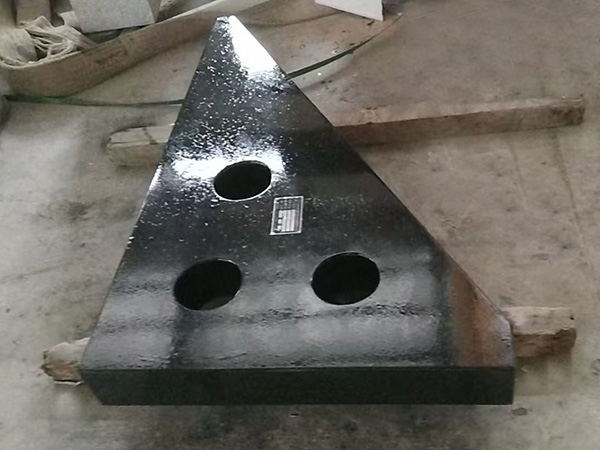
This article explains the engineering case for granite as a structural material, what can realistically be machined and inserted, how to specify tolerances, and how these components are installed and maintained.
1. The Engineering Case for Granite Structures
Granite is not chosen for strength; it is chosen for stability. Four properties do most of the work:
Dimensional stability: natural stone that has been geologically aged carries essentially no internal stress, so it does not creep or relieve over time the way a casting can.
Thermal behaviour: low coefficient of thermal expansion and slow thermal response mean the structure moves very little during normal workshop temperature drift.
Vibration damping: granite absorbs energy better than steel or aluminium, which shortens settling time and improves measurement repeatability.
Corrosion and magnetism: it does not rust, is non-magnetic, and is electrically non-conductive — valuable around sensors, magnetic bearings and precision electronics.
The trade-off is that granite is brittle and weak in tension. A granite base must be designed so that loads are carried in compression and so that point impacts and bending moments are avoided.
2. What Can Be Manufactured in Granite
| Component type | Typical application | Key requirement |
|---|---|---|
| Machine bases and beds | CMM, optical inspection, laser equipment | Flatness and stability of the mounting plane |
| Beams, bridges and columns | Gantry structures, measuring frames | Straightness, squareness, low mass-to-stiffness error |
| Drilled and bushed platforms | Fixturing, vacuum or threaded grids | Insert position accuracy and pull-out strength |
| Air-bearing rails and ways | Ultra-precision motion systems | Surface finish and flatness over long lengths |
| Custom brackets and fixtures | Sensor mounts, test rigs, assembly jigs | Dimensional accuracy to drawing |
| Square rulers, straightedges, parallels | Inspection and setup | Squareness, straightness, parallelism |
3. Inserts, Drilling and Bushing: Designing for Assembly
The most common design question is how to attach anything to stone. The answer is metallic inserts bonded or mechanically anchored into prepared holes. Drilled and bushed marble platforms are produced this way: holes are positioned to drawing, bushings are installed, and the assembly is finished so that the inserts sit flush and true.
Plan inserts at the design stage. Positioning, depth and edge distance must be considered together, not added later.
Specify thread and load requirements. Pull-out strength depends on the anchoring method and the distance from edges and other holes.
Allow for finish grinding after insert installation. This guarantees that the insert plane and the working plane remain in the specified relationship.
Consider serviceability. Inserts should be replaceable, or the design should tolerate a repair insert.
4. Specifying Tolerances Realistically
Granite components can be finished to very tight tolerances, but every additional micron costs finishing time and verification effort. Specify to the requirement, not to the limit of the process:
Flatness: state the grade and the area over which it applies; ask whether it is verified in the free, supported condition.
Straightness and squareness: state the reference edges and how they are measured.
Surface finish: important for air bearings and for sliding contact; less critical for structural faces.
Hole/insert positions: state true-position tolerance rather than a linear tolerance chain.
Environmental conditions: state the temperature at which tolerances apply, since verification is temperature-dependent.
5. Installation and Handling
Most damage to granite components happens between delivery and commissioning. A short set of rules prevents almost all of it:
Lift with slings or a frame rated for the mass; never lift by an insert or by an edge.
Support at the designated points — three-point support is standard for large plates and bases.
Level using precision leveling pads or shims, then re-verify flatness after levelling.
Isolate from floor vibration where measurement repeatability is critical.
Protect edges with covers when the machine is not in use.
6. Maintenance and Service Life
| Task | Frequency | Purpose |
|---|---|---|
| Clean with a dedicated stone cleaner | Weekly or per use | Removes dust that affects sliding and measurement |
| Inspect insert torque and condition | Quarterly | Prevents spalling and loose fixtures |
| Check levelling | Quarterly | Settlement changes geometry over time |
| Re-verify flatness / geometry | Annually | Traceable evidence for quality systems |
| Re-lapping on site | When wear or damage occurs | Restores accuracy without replacement |
FAQ: Granite Mechanical Components
Can granite replace a cast iron or steel machine base?
Where the priority is stability, damping and corrosion resistance rather than impact strength, yes — and it is common practice in metrology and optics. Where the structure will take impact or high tensile load, metal remains the safer choice. Hybrid designs, with a granite reference plane on a welded steel frame, are also widely used.
How long does a granite base last?
Decades, in normal service. Granite does not age, rust or stress-relieve. The components that wear are the inserts and the contact surfaces, both of which are serviceable.
Can you machine to our drawings?
Yes. Custom granite components are produced from customer drawings, including drilling, bushing, slotting and insert installation, with final grinding and lapping. Send drawings in STEP or DWG format with the required tolerances and operating environment.
Botou Bozhong Precision Machine Tool Co., Ltd. manufactures granite surface plates, drilled and bushed marble platforms, granite square rulers, parallel straightedges, right-angle rulers and custom granite mechanical components, and provides on-site installation, grinding and lapping. Drawings with tolerances, insert positions and operating conditions are enough for a manufacturing review.
-
Granite Mechanical Components: Why Precision Machines Are Built on Marble Bases
-
Granite Surface Plate vs Cast Iron Surface Plate: Which Measuring Base Should You Specify?
-
Cast Iron Surface Plate Grades and Accuracy: How to Specify What You Actually Need
-
Cast Iron T-Slot Base Plate: Splicing, Sizes, Load Ratings and Installation
-
Cast Iron 3D Welding Table with Fixtures: A Modular Tooling Guide
-
D16 vs D28 Steel Welding Table: How to Choose the Right Hole System
Botou Bozhong Precision Machine Tool Co., Ltd.
Copyright © 2025-2026 https://www.bozhong-weldingtable.com. All Rights Reserved Botou Bozhong Precision Machine Tool Co., Ltd.Copyright