






- Navigation -
 Current Location:
NEWS DETAILS
NEWS INFORMATION
Cast Iron T-Slot Base Plate: Splicing, Sizes, Load Ratings and Installation
AUTHOR:Bozhong Tool DATE:2026-10-08 11:39:35 HITS:95
A cast iron T-slot base plate — also called a T-slot workbench or T-groove flat plate — is the quiet workhorse of the assembly and inspection bay. It serves as the reference base for assembling machine tools, as a fixture bed for large weldments, as a layout surface, and as a mounting base for test rigs and motor test benches. Unlike a hole-system table, it accepts conventional T-bolts and clamps anywhere along the slot, which makes it the more flexible choice for very large or irregular work.
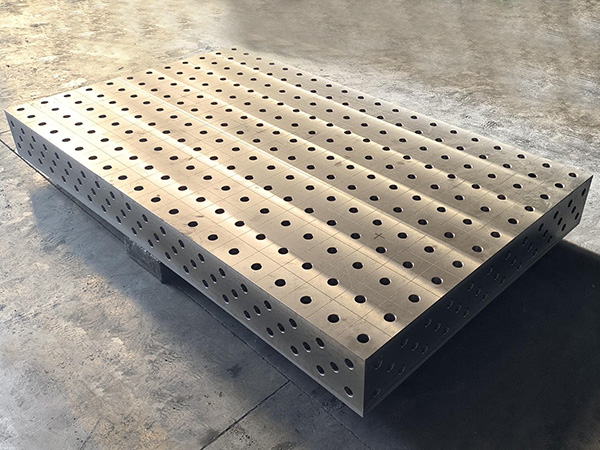
This guide covers slot sizing, the practicalities of splicing plates into a large continuous surface, how to read load ratings, and the installation and inspection practices that keep the plate within grade.
1. Reading a T-Slot Specification
A T-slot plate is defined by more than its outline dimensions. The slot geometry determines which bolts and clamp heads fit, and how much pull-out force a clamp can develop before the slot deforms.
| Parameter | What it controls | Buyer's question |
|---|---|---|
| Slot width / nominal size | Which T-bolts and clamp heads can be used | Is it compatible with the clamps we already own? |
| Slot pitch (spacing) | How finely clamps can be positioned | Can I get a clamp where I need it on this part? |
| Slot depth and undercut | Pull-out strength and bolt engagement | Will the slot hold under our clamping loads? |
| Plate thickness and ribbing | Stiffness and deflection under load | How much does the surface deflect at full load? |
| Surface flatness grade | Accuracy of anything assembled or measured on it | What grade is guaranteed over the full surface? |
| Material grade | Strength, damping and machinability | Which cast iron grade, and is it stress-relieved? |
2. Splicing: Building a Large Working Surface
When a single casting cannot cover the workpiece, plates are spliced. Splicing is a genuine engineering operation, not a matter of pushing two plates together, and the joint is where most large installations lose accuracy.
Machine the joint faces so that the mating edges are square and matching, with provision for dowels or keys to prevent relative movement.
Anchor to a common foundation. A spliced assembly needs a prepared base; otherwise the sections settle independently.
Align, then verify across the joint. Do not verify each half separately and assume the result — measure continuously over the joint line.
Finish on site. Scraping and lapping after assembly is what turns an aligned pair of plates into a single reference surface.
Plan the slot continuity so that clamps can cross or approach the joint without dead zones.
3. Static vs. Dynamic Load: Reading the Rating Honestly
Load ratings are frequently quoted as a single number, which hides the important distinction. Static load is the weight the plate carries while nothing moves. Dynamic load includes the additional forces generated by clamping, welding, impact, vibration or moving equipment mounted on the plate.
A plate carrying a heavy assembly can be at its static limit and still be perfectly safe.
Add welding forces, impact from loading, or a running machine on top, and the effective load rises well above the static figure.
Deflection, not breakage, is usually the first limit reached. The question is how much the surface bends, and whether that bend still allows the work to be assembled within tolerance.
When you enquire, state the maximum workpiece mass, how it will be loaded (crane, forklift, manual handling), and whether any process on the plate generates force or vibration. Those answers let a supplier size thickness and ribbing correctly.
4. Material, Stress Relieving and Machining
T-slot plates are produced in grey cast iron grades selected for compressive strength, damping and machinability. Two process steps matter greatly to the buyer because they determine whether the plate stays flat:
Stress relieving / ageing: internal casting stresses must be relieved before finish machining, otherwise the plate will slowly move after it is put into service.
Finish machining and scraping: the working surface and the slots are machined after stress relieving, then hand-scraped or ground to the specified grade.
Ask whether the plate you are buying has been stress-relieved and whether final finishing occurs after that step. It is one of the cheapest questions to ask and one of the most expensive to discover later.
5. Installation: Levelling, Anchoring and Support
A precision plate on a poor foundation is simply a heavy object. Installation should follow a defined sequence:
Prepare a foundation capable of carrying the total load without settlement.
Position the plate and rough-level it with machine tool leveling pads / adjustment shims at the designated support points.
Fine-level using a precision level or measuring instrument, working diagonally across the surface rather than along one edge only.
Verify flatness over the full surface, including across any joints.
Anchor, then re-verify — anchoring changes the level.
Record the as-installed readings as the baseline for future inspection.
6. Inspection and Maintenance Routine
| Interval | Action | Purpose |
|---|---|---|
| Daily | Clean surface and slots, remove swarf and debris | Prevent raised burrs and seating problems |
| Weekly | Check that clamping bolts torque correctly in the slots | Catch slot deformation early |
| Quarterly | Visual check for damage, corrosion and slot edge burrs | Prevent small defects becoming accuracy loss |
| Annually | Re-verify flatness against the installation baseline | Detect slow drift before it affects output |
| After any overload | Full verification and re-scraping if required | Restore grade after an incident |
FAQ: Cast Iron T-Slot Base Plates
T-slot plate or hole-system welding table?
Choose a T-slot plate where the work is very large, irregular, or clamped with conventional T-bolts, or where the plate doubles as an assembly and inspection reference. Choose a hole-system table where rapid, repeatable fixture setups of similar parts dominate.
Can existing plates be extended?
Yes, provided the mating faces are machined for a joint and the foundation can carry the additional load. Extension is a common route for growing production without replacing the original investment.
What should I specify when I enquire?
Outline dimensions, slot size and pitch, required flatness grade, maximum static and dynamic load, support arrangement, foundation conditions, and any on-site finishing requirement. Drawings or photos of the intended application make the quotation far more accurate.
Botou Bozhong manufactures cast iron T-slot base plates, cast iron surface plates, motor test plates and large machine tool castings, and provides on-site installation, scraping and lapping services. Outline dimensions, slot size, grade and load requirements are enough for our engineers to prepare a quotation.
-
Cast Iron T-Slot Base Plate: Splicing, Sizes, Load Ratings and Installation
-
Cast Iron 3D Welding Table with Fixtures: A Modular Tooling Guide
-
D16 vs D28 Steel Welding Table: How to Choose the Right Hole System
-
D16 Welding Table Hole System: A Complete Buyer's Guide for Fabrication Shops
-
Welding Table Surface Hardness — What Rockwell and Brinell Numbers Mean for Buyers
-
Welding Table Load Capacity — Understanding Static and Dynamic Ratings
Botou Bozhong Precision Machine Tool Co., Ltd.
Copyright © 2025-2026 https://www.bozhong-weldingtable.com. All Rights Reserved Botou Bozhong Precision Machine Tool Co., Ltd.Copyright