






- Navigation -
 Current Location:
NEWS DETAILS
NEWS INFORMATION
Gray Iron Castings for Machine Beds: HT200, HT250 and HT300 Material Guide
AUTHOR:Bozhong Tool DATE:2026-10-11 16:15:30 HITS:50
The bed is the foundation of a machine tool. Its job is not to be strong in the way a shaft is strong; its job is to hold the relationship between the spindle, the guideways and the workpiece while loads, temperature and time all try to change it. That is why gray iron castings for machine beds remain the default material after more than a century of machine building: no other material delivers the same combination of damping, compressive strength, castability and cost.
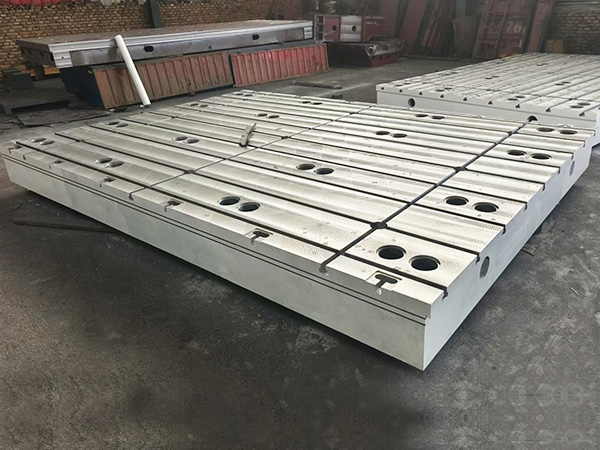
This guide explains what the common material designations mean, how to select a grade for a given machine, which process steps determine whether a bed stays accurate, and what to put into a purchase specification.
1. Why Grey Cast Iron for Machine Beds
Grey cast iron contains graphite in flake form. Those flakes are the reason the material behaves the way it does:
Damping: the graphite flakes absorb vibrational energy, which is why cast beds settle quickly and produce better surface finish on the workpiece.
Compressive strength: excellent, which suits a structure loaded mainly in compression.
Wear and sliding behaviour: graphite acts as a solid lubricant, so cast iron slideways run well against each other.
Castability: complex ribbed shapes, cores and thick-to-thin transitions can be produced in one piece.
Machinability: chips break cleanly and cutting forces are moderate, which keeps finishing economical.
The trade-off is brittleness and low tensile strength. Bed design compensates with ribbing, generous section transitions and correct support, and the material is not used where high tensile or shock loading dominates.
2. HT200, HT250, HT300: Reading the Designations
The numbers refer to the specified minimum tensile strength in megapascals. Higher numbers mean a stronger, denser, less ductile iron — and generally better wear resistance, but more care required in casting heavily restrained sections.
| Grade | Character | Typical machine tool application |
|---|---|---|
| HT200 | Good strength, excellent castability and damping | Bases, housings, covers, general-purpose beds |
| HT250 | Higher strength and wear resistance, still readily machinable | Machine beds, columns, worktables, slideway bodies |
| HT300 | High strength and hardness for heavily loaded ways | Precision grinder and machining-centre beds, heavily loaded structural parts |
The most common specification error is to specify the highest grade available on the assumption that stronger is better. In a bed with thick sections and restrained geometry, a higher-strength iron is more prone to casting stress and cracking, and it is also harder to machine. Grade selection should follow the loads and the geometry, not the datasheet maximum.
3. The Process Steps That Decide Whether a Bed Stays Accurate
Two castings from the same drawing can perform very differently. The difference is almost always in the process, not the pattern.
Melting and composition control. Carbon equivalent, inoculation and pouring temperature determine graphite form and section consistency.
Moulding and core practice. Sand control, gating and feeding determine whether the casting is sound or carries shrinkage and inclusions in critical areas.
Shakeout and cooling. Cooling too quickly through the critical range builds internal stress into the casting.
Stress relieving and ageing. Thermal stress relief, and natural or artificial ageing, allow the casting to reach a stable state before metal is removed.
Rough machining, then a second stabilising treatment if required. For high-precision beds, a second stress relief between rough and finish machining is common practice.
Finish machining and inspection. Dimensional and geometric verification, plus non-destructive testing where specified.
Ask any prospective supplier which of these steps are standard and which are optional. A quotation that includes only moulding, pouring and rough machining is not comparable with one that includes stress relief, ageing, finish machining and inspection.
4. Design Guidance for Cast Beds
Keep wall thickness as uniform as possible; where thickness must change, transition gradually.
Use ribbing to gain stiffness without adding mass — stiffness, not weight, resists deflection.
Avoid sharp corners and abrupt section changes that create hot spots and shrinkage.
Provide adequate fillets at rib-to-wall junctions.
Think about how the casting will be lifted, supported and machined when designing the pattern.
Allow machining allowance on all functional faces and datum surfaces.
5. What to Put Into a Purchase Specification
| Item | Why it matters |
|---|---|
| Material grade (e.g. HT250) | Sets strength, hardness and machinability expectations |
| Hardness range on the as-delivered casting | Affects machining time and tool life |
| Stress relieving / ageing requirement | Determines long-term dimensional stability |
| Machining allowance and datum definition | Avoids disputes over what 'finished' means |
| Geometric tolerances on critical faces | Ties the casting to how it will be assembled |
| NDT requirement (UT, MT, PT) and acceptance level | Controls internal and surface defect risk |
| Surface finish and appearance criteria | Defines expectations for visible areas |
| Documentation: material certificate, inspection report | Provides traceability for quality systems |
6. Typical Machine Tool Castings Supplied
Machine beds and base castings for lathes, machining centres, borers and grinders.
Columns, crossbeams and structural frames.
Worktable castings and T-slot tables.
Headstocks, tailstocks, housings and gearbox bodies.
Large and medium castings in a range of material grades, to drawing.
FAQ: Grey Iron Machine Bed Castings
Why not weld a steel base instead?
Welded steel structures are lighter and faster to produce for one-offs, and they are the right choice in some designs. Cast iron wins where vibration damping and long-term stability matter, and where complex ribbed geometry must be produced economically in volume.
How much machining allowance should be specified?
It depends on casting size and section thickness, and on whether the part has been stabilised. Discuss it with the foundry at the drawing stage; too little allowance risks exposing subsurface defects, and too much adds cost and can shift the stress balance of the section.
Can a distorted casting be corrected?
Sometimes. Re-stress-relieving followed by re-machining can recover a casting that has moved; a casting with significant shrinkage or cracking in a critical section generally cannot be salvaged. This is why process control upstream is the real insurance.
Botou Bozhong Precision Machine Tool Co., Ltd. is based in Botou, Hebei — a long-established casting centre adjacent to Tianjin Port — and supplies gray iron castings for machine beds, machine tool structural parts, worktable castings and large castings in HT200–HT300 grades. Drawings with material grade, section thickness, heat treatment and inspection requirements are enough for a foundry review and quotation.
-
Gray Iron Castings for Machine Beds: HT200, HT250 and HT300 Material Guide
-
Granite Mechanical Components: Why Precision Machines Are Built on Marble Bases
-
Granite Surface Plate vs Cast Iron Surface Plate: Which Measuring Base Should You Specify?
-
Cast Iron Surface Plate Grades and Accuracy: How to Specify What You Actually Need
-
Cast Iron T-Slot Base Plate: Splicing, Sizes, Load Ratings and Installation
-
Cast Iron 3D Welding Table with Fixtures: A Modular Tooling Guide
Botou Bozhong Precision Machine Tool Co., Ltd.
Copyright © 2025-2026 https://www.bozhong-weldingtable.com. All Rights Reserved Botou Bozhong Precision Machine Tool Co., Ltd.Copyright