






- Navigation -
 Current Location:
NEWS DETAILS
NEWS INFORMATION
3D Welding Table: The Ultimate Guide for Precision Fabrication
AUTHOR:Bozhong Tool DATE:2026-05-02 15:25:02 HITS:82
In contemporary metalworking processes, precision and consistent repeatability are indispensable prerequisites for producing high-quality fabricated products. As a cornerstone tool in workshops that prioritize accuracy, efficiency, and uniformity, the 3D welding table has revolutionized how fabricators approach their craft. Characterized by a grid of precisely machined holes on multiple surfaces, this tool enables manufacturers to position and secure workpieces in three dimensions, thereby greatly enhancing alignment precision and optimizing welding results. Key terms such as 3D welding table, welding fixture table, modular welding table, precision welding platform, and fabrication table system are fundamental to grasping its industrial significance.
What Is a 3D Welding Table?
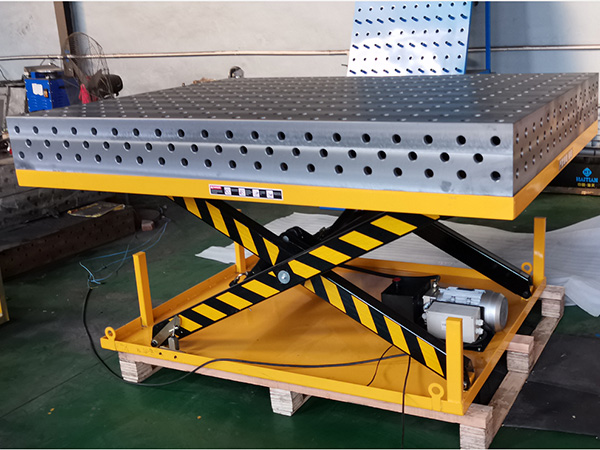
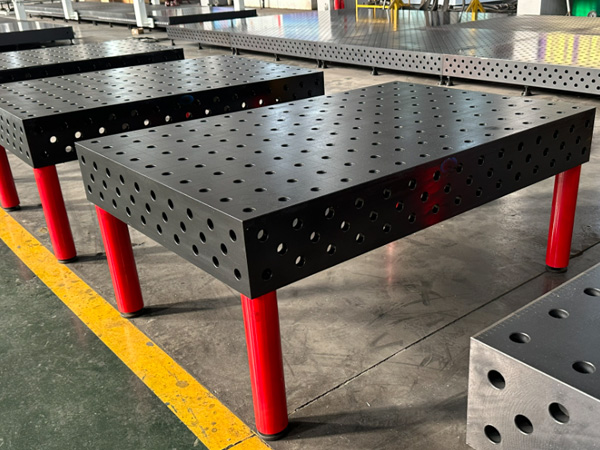
A 3D welding table is a heavy-duty fabrication platform that features a standardized pattern of holes across its tabletop and often its side surfaces. These holes are designed to accommodate clamps, stops, and positioning accessories, turning the table into a fully modular fixturing system. Unlike conventional flat tables, a 3D welding table supports multi-angle setups, allowing complex assemblies to be finished with exceptional dimensional accuracy. This makes it an irreplaceable tool in industries where tight tolerances and consistent repeatability are non-negotiable.
Precision Engineering and Manufacturing Standards
The performance of a 3D welding table is directly tied to its manufacturing precision. High-quality models are typically CNC-machined to achieve flatness tolerances within fractions of a millimeter. Hole diameters—most commonly 16mm or 28mm—and grid spacing are standardized to ensure compatibility with a broad range of accessories. Materials like S355 steel or hardened tool steel are frequently used in construction, with surface treatments such as nitriding or plasma nitriding applied to boost wear resistance. These engineering standards guarantee that the precision welding platform remains stable and accurate even after prolonged use.
Modular Fixturing for Complex Fabrication
One of the primary advantages of a modular welding table is its exceptional flexibility. Fabricators can configure fixtures using clamps, angle brackets, and locator pins to fit workpieces of various shapes and sizes. This modular design eliminates the need for custom jigs, resulting in significant time and cost savings. For projects involving frames, enclosures, or irregular geometries, a welding fixture table offers the adaptability needed to maintain alignment throughout the entire welding process.
Improving Accuracy and Repeatability
Repeatability is a critical aspect of industrial fabrication, particularly for batch production. A 3D welding table allows operators to replicate setups with minimal variation by leveraging fixed reference points and standardized accessories. Once a configuration is established, it can be reused for identical parts, ensuring consistent quality across all production runs. This capability is especially valuable in automotive, aerospace, and machinery manufacturing, where dimensional accuracy directly influences product performance and reliability.
Enhancing Workflow Efficiency
Efficiency on the shop floor is closely connected to how quickly and accurately setups can be completed. A fabrication table system streamlines workflow by reducing measurement time and minimizing repositioning errors. Operators can rapidly secure components using compatible clamps and fixtures, freeing up more time to focus on welding rather than alignment tasks. This not only boosts productivity but also cuts down on labor costs and material waste caused by misalignment issues.
Material Durability and Surface Treatment
Durability is a key trait of a high-quality 3D welding table. Exposed to heat, welding spatter, and mechanical stress, the table’s surface must resist deformation and wear. Plasma nitriding is a widely adopted surface treatment that enhances surface hardness while preserving the core toughness of the material. This process significantly extends the table’s lifespan and maintains the precision of its hole system. Choosing a table with appropriate surface treatment ensures long-term reliability, especially in high-volume production environments.
Applications Across Industries
The versatility of a 3D welding table makes it suitable for a diverse range of industries. In automotive manufacturing, it is used for assembling chassis components and structural frames. In construction and steel fabrication, it supports the production of beams, brackets, and custom metal structures. Aerospace applications benefit from its precision when working with lightweight alloys and complex geometries. Additionally, it is widely utilized in metal furniture production and custom fabrication workshops where both flexibility and accuracy are equally important.
Choosing the Right 3D Welding Table
Selecting the appropriate 3D welding table involves evaluating several key technical factors. Table size should align with the scale of your typical projects, while hole diameter and spacing must match your existing tooling. Load capacity is another critical consideration, especially for heavy-duty applications. It is also important to verify manufacturing standards, certifications, and the supplier’s reputation to ensure the product meets industry requirements. Investing in a reliable modular welding table can have a significant positive impact on both productivity and product quality.
Maintenance and Best Practices
To preserve accuracy and extend the service life of a 3D welding table, regular maintenance is essential. Cleaning the surface after each use prevents slag buildup and corrosion. Periodic inspection of hole integrity ensures that fixtures remain securely positioned. It is also recommended to use compatible accessories to avoid damaging the table surface. Proper storage and handling further contribute to maintaining the performance of the welding fixture table over time.
Conclusion
A 3D welding table is far more than just a work surface—it is a precision tool that elevates accuracy, efficiency, and repeatability in fabrication processes. By integrating modular fixturing, high-quality materials, and advanced manufacturing standards, it supports a wide array of industrial applications. For professionals seeking consistent results and long-term reliability, investing in a high-quality 3D welding table is a strategic decision that delivers measurable benefits in both performance and productivity.
References
GB/T 7714: Modular Welding Tables vs. Fixed: Key Benefits, Common Pitfalls, and the Forster Advantage. Precision Welding Journal
MLA: What is the Lifespan of a 3D Welding Table? Journal of Metal Fabrication Technology
APA:Precision Enhancement of Modular Welding Tables in Aerospace Fabrication. Aerospace Manufacturing and Design
-
D16 vs D28 Grid Systems — Choosing the Right Hole Pattern for Your Welding Table
-
Common Defects in Cast Iron Surface Plates and Practical Solutions
-
Welding Table Safety Regulations and Operator Protection Standards
-
T-Slot Tables in Industrial Manufacturing: A Complete Applications Guide
-
Machine Tool Castings: Fundamentals, Manufacturing Process, and Quality Standards
-
HT300 Cast Iron vs Q355 Steel: Choosing the Right Welding Table Material
Botou Bozhong Precision Machine Tool Co., Ltd.
Copyright © 2025-2026 https://www.bozhong-weldingtable.com. All Rights Reserved Botou Bozhong Precision Machine Tool Co., Ltd.Copyright