






- Navigation -
 Current Location:
NEWS DETAILS
NEWS INFORMATION
Cast Iron Welding Tables: Durability and Long-Term Performance Analysis
AUTHOR:Bozhong Tool DATE:2026-06-14 18:05:31 HITS:109
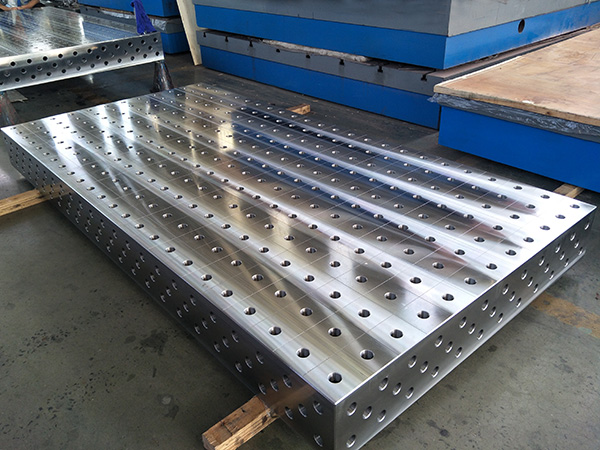
When a factory invests in a welding table, it is making a commitment that is meant to last for years, sometimes decades. The choice of material for that table has a profound impact on its longevity, its ability to maintain accuracy under demanding conditions, and the total cost of ownership over its service life. Cast iron has been the material of choice for precision welding tables for well over a century, and modern engineering has only reinforced the reasons why this traditional material continues to outperform newer alternatives in critical applications.
The Unique Properties of Cast Iron
Cast iron is an alloy of iron, carbon, and silicon, with a carbon content typically between two and four percent. This composition gives cast iron a remarkable combination of properties that make it exceptionally well-suited for welding table applications. Most importantly, graphite flakes within the microstructure act as internal stress relievers, absorbing and dampening the vibrations generated by welding operations and heavy mechanical impacts.
No other material used in fabrication equipment offers this combination of vibration damping, machinability, and cost-effectiveness. Steel, while stronger in pure tensile terms, lacks the damping capacity of cast iron and tends to transmit vibrations directly into the workpiece and the surrounding structure. For precision welding applications where thermal and mechanical stability are paramount, cast iron remains the preferred choice among experienced fabrication engineers.
Superior Flatness Retention Under Thermal Stress
Welding generates intense localized heat that causes thermal expansion and contraction cycles in the workpiece and the table surface supporting it. Over time, this cyclic thermal loading can cause some materials to warp or distort. Cast iron microstructure provides a natural resistance to this effect, and the annealing processes applied during manufacturing further enhance dimensional stability in demanding production environments.
Premium cast iron tables undergo stress-relief annealing in controlled furnace environments, a process that eliminates internal casting stresses before the table is ever used on the production floor. The result is a table that maintains its flatness specification through years of heavy welding use without the gradual drift toward out-of-tolerance conditions that affects lesser materials.
Wear Resistance and Surface Durability
The wearing surface of a cast iron welding table develops a natural work-hardened layer through use, particularly in areas that experience repeated clamping and workpiece repositioning. This self-hardening characteristic means that the table actually becomes more resistant to wear over time, rather than gradually degrading as might be expected with other materials under constant industrial use.
When the surface does eventually show significant wear, cast iron tables can be re-machined to restore original flatness tolerances - a process that is practical and cost-effective compared to replacing the entire table. Multiple re-machining cycles can extend the useful life of a quality cast iron table to thirty years or more, making the initial investment remarkably economical over time for factories that plan for the long term.
Load Capacity and Structural Rigidity
Cast iron tables are capable of supporting extremely heavy workloads without deflection or loss of accuracy. The material compressive strength and modulus of elasticity combine to provide a rigid platform that does not flex under load, ensuring that workpieces remain exactly where they were positioned throughout the welding process. This stability is particularly important for complex multi-pass welds where any movement during cooling can introduce stresses that compromise the integrity of the final assembly.
Heavy fabrication operations - welding large structural assemblies, thick-walled pressure vessels, or massive machine frames - benefit enormously from this rigidity. The table becomes a stable reference surface that operators can trust, reducing the need for constant repositioning and realignment during complex welding sequences. This reliability translates directly into improved productivity and reduced rework on the production floor.
The Economics of Cast Iron Over the Long Run
While the initial purchase price of a cast iron welding table may be higher than a fabricated steel alternative, the total cost of ownership tells a very different story over a multi-year operating period. When you factor in the extended service life, the ability to restore flatness through re-machining, the superior accuracy retention, and the reduced need for rework due to table distortion, cast iron tables consistently deliver lower lifecycle costs than their competitors. Most factories recover the additional upfront investment within the first two to three years of operation through improved quality and reduced maintenance costs.
For factories that view their welding tables as long-term production assets rather than consumable equipment, cast iron remains the rational and economical choice that delivers value year after year. Reputable manufacturers typically offer warranties of five years or more on their cast iron tables, a testament to their confidence in the material durability and manufacturing quality.
References:
American Welding Society (AWS). Standard Welding Terms and Definitions. AWS A3.0, current edition.
ISO 6943:2015. Welding - Fatigue test for welded joints. International Organization for Standardization.
ASM International. Welding Fundamentals and Processes. ASM Handbook Vol. 6A, 2011.
ESAB. The Fabricator's Guide to Welding Table Selection. ESAB Technical Publications, 2020.
Kalpakjian, S. and Schmid, S. Manufacturing Engineering and Technology. Pearson, 7th edition, 2013.
-
Welding Table Surface Hardness — What Rockwell and Brinell Numbers Mean for Buyers
-
Welding Table Load Capacity — Understanding Static and Dynamic Ratings
-
Modular Welding Table ROI — Calculating Return on Investment for Fabrication Shops
-
Industrial Metrology Basics for Welding Fabrication — Standards, Tools, and Workflows
-
Granite Surface Plate Calibration — Frequency, Methods, and Standards
-
How to Design a Welding Fixture from Scratch — A Step-by-Step Engineering Guide
Botou Bozhong Precision Machine Tool Co., Ltd.
Copyright © 2025-2026 https://www.bozhong-weldingtable.com. All Rights Reserved Botou Bozhong Precision Machine Tool Co., Ltd.Copyright