






- Navigation -
 Current Location:
NEWS DETAILS
NEWS INFORMATION
Flexible Welding Platforms vs Traditional Fixtures: A Comprehensive Comparison
AUTHOR:Bozhong Tool DATE:2026-06-23 20:51:17 HITS:120
The debate between flexible welding platforms and traditional dedicated fixtures is not new, but it has taken on new urgency as manufacturing environments become more complex and product cycles shorten faster than ever before. Factory managers across the globe are asking the same question: should we continue investing in custom jigs and dedicated fixtures, or is it time to switch to flexible, modular welding platforms? The answer requires a careful look at the real-world trade-offs involved in modern fabrication operations.
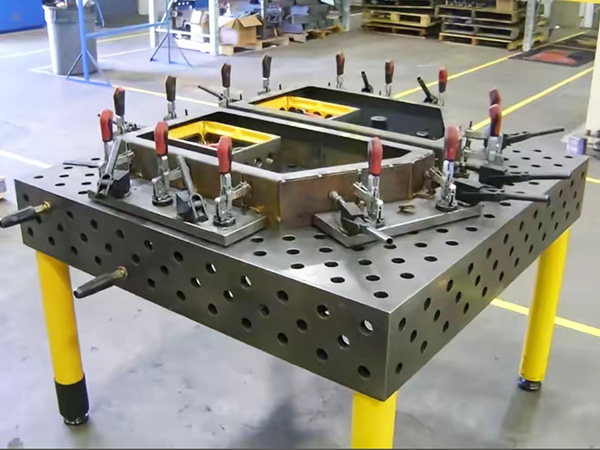
What Traditional Fixtures Bring to the Table
Dedicated fixtures have served the manufacturing industry well for decades. When a factory produces a stable product in high volumes, a custom jig can deliver exceptional repeatability with minimal operator skill required. The fixture is designed once, built to exact specifications, and then used thousands of times to produce identical parts with consistent quality. In the right context, this approach remains highly effective and economically justified for long production runs.
Traditional fixtures also offer exceptional rigidity for specific operations. A purpose-built jig for a particular weldment can be engineered to handle extreme forces with minimal deflection, making it ideal for applications where the workpiece geometry is fixed and the production run is long enough to amortize the fixture cost over many units of output.
The Hidden Costs of Dedicated Fixtures
However, dedicated fixtures carry hidden costs that often go unrecognized until they accumulate into a significant financial burden. The most obvious is the upfront design and fabrication cost. A custom jig can take weeks to design, manufacture, and test before it is ready for production. During this period, the factory cannot begin producing the part, delaying delivery schedules and tying up engineering resources that could be deployed on other value-adding activities.
When product designs change - and in today market, they change with increasing frequency due to customer demands and competitive pressures - custom fixtures often become obsolete or require costly modifications. The cost of redesigning and rebuilding jigs can be substantial, and in some cases, factories find themselves holding onto outdated fixtures that can no longer be used, effectively wasting the original investment and cluttering valuable storage space in the workshop.
Where Flexible Platforms Excel
Flexible welding platforms address these challenges directly and decisively. Instead of building a new fixture for every new product, operators reconfigure the existing grid-based table using standardized components. This reconfigurability eliminates the lead time associated with custom fixture fabrication and allows factories to respond quickly to design changes or new product introductions from customers.
The ability to build complex three-dimensional assemblies on a single platform also reduces the number of workstations needed in a fabrication shop. What once required multiple dedicated setups can now be accomplished on one flexible table, saving valuable floor space and reducing the capital investment required to equip a competitive workshop capable of handling diverse production requirements.
Accuracy and Repeatability in Real-World Use
A common concern about flexible platforms is whether they can match the accuracy of dedicated fixtures in demanding applications. The answer depends largely on the quality of the table and the skill of the operator, but in practice, well-built flexible platforms offer accuracy that meets or exceeds that of custom jigs for the vast majority of applications. The key lies in the precision of the hole pattern and the quality of the clamping components used during setup.
High-quality flexible tables achieve flatness tolerances measured in hundredths of a millimeter, and the standardized hole grid provides reference points that are consistent across the entire working surface. With proper setup techniques, operators can achieve dimensional accuracy that satisfies the most demanding engineering specifications imposed by quality-conscious customers and regulatory bodies.
The ROI Equation for Modern Factories
For factories that produce a variety of products in relatively short runs, the return on investment for flexible platforms is compelling and demonstrable. Consider the cumulative cost of custom fixtures over a five-year period: design fees, fabrication costs, storage requirements, maintenance, and the occasional obsolescence charge. Against this, a single flexible platform plus a modest inventory of standardized accessories represents a fraction of the expenditure while providing far greater versatility.
The agility that flexible platforms provide also translates into a significant competitive advantage in markets where delivery speed and flexibility matter. Factories that can retool quickly for new products win more business and deliver faster than competitors still locked into traditional fixture-dependent workflows that cannot adapt to changing customer requirements with the same speed or efficiency.
References:
American Welding Society (AWS). Standard Welding Terms and Definitions. AWS A3.0, current edition.
ISO 6943:2015. Welding - Fatigue test for welded joints. International Organization for Standardization.
ASM International. Welding Fundamentals and Processes. ASM Handbook Vol. 6A, 2011.
ESAB. The Fabricator's Guide to Welding Table Selection. ESAB Technical Publications, 2020.
Kalpakjian, S. and Schmid, S. Manufacturing Engineering and Technology. Pearson, 7th edition, 2013.
-
How to Design a Welding Fixture from Scratch — A Step-by-Step Engineering Guide
-
Cast Iron vs Steel Welding Tables — A Material Science Perspective
-
Cast Iron Surface Plate Scraping — Restoring Precision by Hand
-
3D Welding Table Accessories — Essential Components for Every Fabrication Shop
-
Welding Distortion Control — Fixture Design Strategies for Precision Fabrication
-
How to Verify the Accuracy of a New Welding Platform on Delivery
Botou Bozhong Precision Machine Tool Co., Ltd.
Copyright © 2025-2026 https://www.bozhong-weldingtable.com. All Rights Reserved Botou Bozhong Precision Machine Tool Co., Ltd.Copyright