






- Navigation -
 Current Location:
NEWS DETAILS
NEWS INFORMATION
Custom 3D Welding Platforms: Tailored Solutions for Complex Fabrication Needs
AUTHOR:Bozhong Tool DATE:2026-06-17 18:10:14 HITS:160
While standard 3D welding tables address the needs of the majority of fabrication shops, there exists a significant segment of the manufacturing industry whose requirements fall outside the scope of catalog products. Large-scale fabrication, specialized production environments, and unique workpiece geometries often demand bespoke solutions that only custom manufacturing can deliver. Understanding when and how to pursue a custom welding platform can be the difference between a production line that struggles and one that excels under demanding conditions.
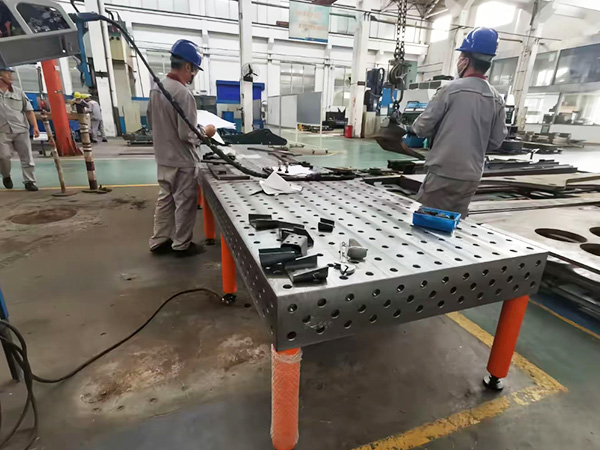
When Standard Tables Are Not Enough
Standard 3D welding tables are typically available in a range of sizes from approximately one meter up to four or five meters in length. For many workshops, these sizes cover their production requirements adequately. However, factories that manufacture large structural components - ship panels, wind turbine towers, bridge sections, or aerospace subassemblies - frequently need working surfaces that exceed even these generous dimensions by a considerable margin.
Beyond size, some applications have unusual geometry requirements. Workpieces with non-standard mounting interfaces, deeply recessed features, or irregular shapes may not be adequately served by the standardized hole patterns of catalog tables. In such cases, a custom platform designed around the specific workpiece geometry can eliminate the inefficiencies and inaccuracies of forced fits on inappropriate equipment, delivering measurable improvements in both quality and throughput.
Designing a Custom Welding Platform
Custom 3D welding platform design begins with a thorough analysis of the production requirements. Experienced manufacturers work closely with their customers to understand the full scope of the application: the types and sizes of workpieces to be processed, the welding processes to be used, the required tolerances, the production volumes, and any environmental factors that may affect equipment performance over time.
This information informs the engineering decisions that shape the custom table: the overall dimensions, the hole pattern layout and spacing, the choice of materials and surface treatments, the design of the support structure, and the integration of specialized features such as built-in grounding points, cooling channels, or tooling integration plates. The goal is to create a platform that is precisely matched to the production requirements, eliminating compromises that come from forcing a standard product into a non-standard application.
Material and Construction Customization
Custom platforms can be manufactured from materials selected for the specific demands of the application. While gray iron remains the most common choice for general-purpose tables, specialized applications may benefit from nodular iron for improved strength, alloy steels for superior wear resistance, or even aluminum for reduced weight in applications where portability is important and floor loading is a constraint.
The internal structure of the table can also be customized with precision. Heavy-duty ribbing and cross-bracing can be incorporated into the casting or fabrication to provide maximum rigidity under extreme loads, while maintaining the overall flatness and accuracy required for quality-critical welding operations. For applications involving high-volume welding, integrated water cooling channels can be built into the table structure to manage thermal loading more effectively than passive cooling alone, extending the life of both the table and the tooling mounted on it.
Specialized Features and Integration
Custom welding platforms frequently incorporate features that extend their functionality beyond simple workpiece support. Tooling integration plates allow quick-change tooling systems to be mounted directly to the table surface, eliminating the time spent repositioning tooling for each new job. Precision-machined reference edges and datum surfaces provide additional positioning references for complex assemblies that require multiple alignments during the welding sequence.
The integration of automation components is another growing area of customization in modern fabrication facilities. Robotic welding arms, automated positioning systems, and sensor arrays can all be incorporated into the custom table design, creating a complete intelligent workstation that reduces manual intervention and improves consistency across high-volume production runs. This level of integration is particularly valuable for factories that are transitioning toward smart manufacturing practices.
Working with the Right Manufacturer
Custom welding platform projects require a manufacturer with both engineering expertise and fabrication capability. Not all suppliers who sell standard catalog tables have the capacity or experience to execute custom projects successfully. Factories should seek out manufacturers with a documented track record of custom engineering, appropriate certifications for their industry, and the willingness to engage in detailed technical dialogue before, during, and after the project.
The investment in a custom 3D welding platform is significant, but for factories with genuinely specialized requirements, it is an investment that pays dividends in improved quality, reduced setup times, and production capabilities that would simply not be possible with standard equipment. A well-designed custom platform becomes a competitive advantage that differentiates the factory from competitors still relying on improvised or inadequate workstation setups.
References:
American Welding Society (AWS). Standard Welding Terms and Definitions. AWS A3.0, current edition.
ISO 6943:2015. Welding - Fatigue test for welded joints. International Organization for Standardization.
ASM International. Welding Fundamentals and Processes. ASM Handbook Vol. 6A, 2011.
ESAB. The Fabricator's Guide to Welding Table Selection. ESAB Technical Publications, 2020.
Kalpakjian, S. and Schmid, S. Manufacturing Engineering and Technology. Pearson, 7th edition, 2013.
-
D16 vs D28 Grid Systems — Choosing the Right Hole Pattern for Your Welding Table
-
Common Defects in Cast Iron Surface Plates and Practical Solutions
-
Welding Table Safety Regulations and Operator Protection Standards
-
T-Slot Tables in Industrial Manufacturing: A Complete Applications Guide
-
Machine Tool Castings: Fundamentals, Manufacturing Process, and Quality Standards
-
HT300 Cast Iron vs Q355 Steel: Choosing the Right Welding Table Material
Botou Bozhong Precision Machine Tool Co., Ltd.
Copyright © 2025-2026 https://www.bozhong-weldingtable.com. All Rights Reserved Botou Bozhong Precision Machine Tool Co., Ltd.Copyright