






- Navigation -
 Current Location:
NEWS DETAILS
NEWS INFORMATION
D16 vs D28 Steel Welding Table: How to Choose the Right Hole System
AUTHOR:Bozhong Tool DATE:2026-10-06 10:42:14 HITS:106
The most common question buyers ask once they have committed to a modular system is simple and consequential: D16 or D28? Both are hole-system welding tables built from low-alloy steel, both accept a wide family of clamps and stops, and both will outlast several generations of dedicated jigs. The difference is where each one performs best — and choosing the wrong one leaves you with a table that is either overloaded or over-specified.
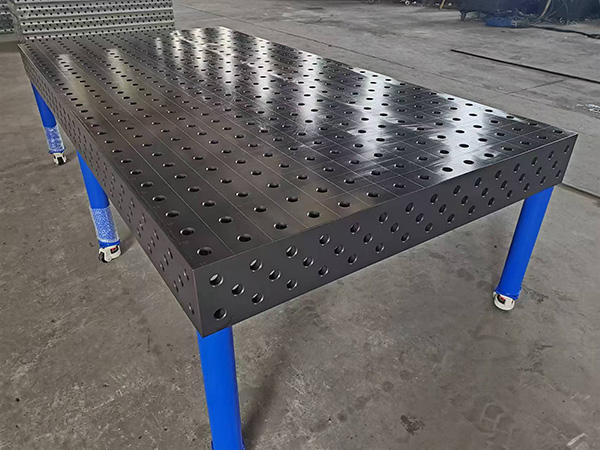
This comparison sets out the decision in engineering terms: hole diameter and clamp capacity, workpiece scale, duty cycle, accuracy expectations, accessory availability, and the true cost of the system over its life.
1. The Core Difference: Hole Diameter and Clamp Capacity
A D16 welding table uses a 16 mm hole system; a D28 steel welding table uses a 28 mm system. Everything downstream follows from that single dimension. A larger bore accepts a larger clamping shank, which in turn accepts higher clamping force and greater moment resistance. If your work is light-gauge sheet and small frames, that extra capacity is dead weight. If your work is structural sections and heavy weldments, it is exactly what you need.
| Decision factor | D16 welding table | D28 steel welding table |
|---|---|---|
| Hole diameter | 16 mm system | 28 mm system |
| Typical workpiece scale | Small to medium fabrications, sheet and light sections | Medium to heavy weldments, structural sections |
| Clamping capacity | Standard quick-lock clamps and stops | Heavy-duty clamps with higher holding force |
| Fixturing resolution | Finer positioning on tight layouts | Coarser, but adequate for large parts |
| Table mass / stiffness | Lighter, easier to relocate in the cell | Heavier, higher inertia against welding forces |
| Best fit | Job shops, prototypes, repeat small batches | Heavy fabrication, large frames, high clamp loads |
2. Workpiece Scale: The First Question to Answer
Before looking at any datasheet, quantify what you actually build. Take your ten heaviest recurring assemblies and record their mass, their largest dimension, and the height of the centre of gravity above the table surface. Those three numbers decide more than any marketing claim.
Largest dimension under roughly 1.5 m and mass under a few hundred kilograms: D16 will normally be the more economical and more precise choice.
Assemblies that need long reach arms, tall vertical fixtures or heavy section material: the higher clamping capacity of D28 starts to pay off.
Mixed workload: many shops run a D16 cell for small work and a single D28 station for the heavy jobs. The two are not mutually exclusive; they solve different problems.
3. Duty Cycle and the Reality of Clamping Force
Welding generates force in two ways: the mechanical force of clamping, and the force of the weldment pulling itself out of shape as it cools. Distortion is the enemy of repeatability, and resisting distortion requires holding force at the right points — not just a heavier table.
This is where the D28 system earns its place. A heavy section that is restrained only lightly will move as the weld bead shrinks; a D28 steel welding table allows the use of clamps with enough capacity to hold the part against that movement, and the table itself has the mass to absorb the reaction. On light work, the same clamp is simply oversized: slower to place, harder to fit into a tight layout, and more expensive per station.
4. Accuracy: What Each System Can Realistically Hold
Both systems index from precision-bored holes, so in principle both can hold tight positions. In practice the accuracy you achieve depends on the condition of the bushings and pins, the stiffness of the fixture arms, and the flatness of the table surface. Long, slender fixture arms amplify any clearance: a fractional play at the hole becomes visible movement at the end of the arm.
For that reason, a D16 table with short, rigid fixturing often produces more accurate results than a D28 table with long cantilevered arms. Size the hole system to the load, then design the fixture to be as short and as stiff as the part allows.
5. Accessory Ecosystem and Standardisation
A hole system is only as valuable as the parts that fit it. Before buying, confirm the ecosystem you are committing to:
Availability of quick-locking clamps in several sizes and jaw configurations.
Locating stops, stop rails and angle brackets that index positively into the holes.
Support and riser blocks, plus taller vertical elements for boxed assemblies.
Consumables: locating pins, bushings, hole plugs and cleaning tools — these are replaced far more often than the table.
Whether the supplier can machine custom fixture elements to your drawings, which matters for unusual parts.
Standardising on one system across the shop is usually worth more than optimising each station individually: clamps get shared between cells, training is simpler, and spares inventory stays small.
6. Total Cost of Ownership, Not Purchase Price
The table is typically a minority of the system cost over five years. Clamps, pins, bushings, re-machining and — most importantly — welder setup time dominate. Two cost drivers are easy to underestimate:
Setup time saved per job. A modular table that converts a two-hour layout into a twenty-minute clamp-up returns its cost quickly, especially on repeat work.
Rework avoided. Fixtures that hold position reduce the number of assemblies that must be cut apart and re-welded.
Reconditioning. A hardened low-alloy top in the HB 170–220 range can be dressed and re-verified rather than replaced.
Scalability. Spliced platforms let you extend the working surface later instead of buying a second table.
7. A Practical Selection Checklist
| Your situation | Recommended system |
|---|---|
| Sheet-metal frames, enclosures, small brackets, frequent changeovers | D16 |
| Mixed work with occasional heavy weldments | D16 main cell plus one D28 station |
| Structural steel assemblies, large frames, high clamp loads | D28 |
| Long weldments needing spliced working surface | D28 or spliced platform with verified joint alignment |
| Prototype / R&D cell where layouts change daily | D16 with a full starter clamp kit |
FAQ: Choosing Between D16 and D28
Can I use D16 clamps on a D28 table?
Only with a reducing bushing, and it is a compromise. Bushings add clearance and a wear point, which defeats the accuracy advantage of the finer system. Standardise wherever possible.
Is the D28 table always more accurate because it is heavier?
No. Mass helps damp vibration and resist deflection, but positional accuracy comes from hole geometry, bushing condition and fixture stiffness. A well-maintained D16 table can hold tighter positions than a neglected D28 table.
How do I future-proof the purchase?
Buy the system that matches your heaviest recurring job rather than your average job, and choose a supplier whose accessory range covers both systems. Then document your standard setups so that the table keeps paying back as staff change.
Botou Bozhong manufactures both D16 and D28 low-alloy steel welding tables along with the matching fixture range, and provides on-site installation, debugging, scraping and lapping. For a recommendation based on your actual parts, For a recommendation based on your actual parts, send workpiece drawings, material grades and monthly batch quantities to our engineering team.
-
D16 vs D28 Steel Welding Table: How to Choose the Right Hole System
-
D16 Welding Table Hole System: A Complete Buyer's Guide for Fabrication Shops
-
Welding Table Surface Hardness — What Rockwell and Brinell Numbers Mean for Buyers
-
Welding Table Load Capacity — Understanding Static and Dynamic Ratings
-
Modular Welding Table ROI — Calculating Return on Investment for Fabrication Shops
-
Industrial Metrology Basics for Welding Fabrication — Standards, Tools, and Workflows
Botou Bozhong Precision Machine Tool Co., Ltd.
Copyright © 2025-2026 https://www.bozhong-weldingtable.com. All Rights Reserved Botou Bozhong Precision Machine Tool Co., Ltd.Copyright