






- Navigation -
 Current Location:
NEWS DETAILS
NEWS INFORMATION
Stringent Requirements for Granite Platforms in the Aerospace Industry
AUTHOR:Bozhong Tool DATE:2026-01-17 17:59:29 HITS:124
Why Granite Platforms Matter in Aerospace Applications
In the aerospace industry, precision is not optional—it is mandatory. A granite platform serves as a fundamental reference surface for inspection, measurement, and assembly processes where dimensional accuracy and stability are critical. Even minor deviations can lead to significant performance or safety issues in aerospace components.
From the standpoint of a professional granite platform manufacturer with large-scale production capabilities, aerospace applications demand far higher standards than general industrial use. Granite platforms supplied for this sector must meet stringent requirements in material quality, structural stability, and long-term performance, especially when produced and delivered in batches.
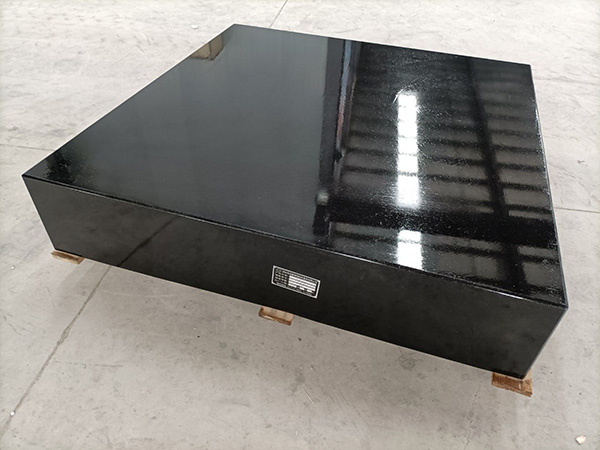
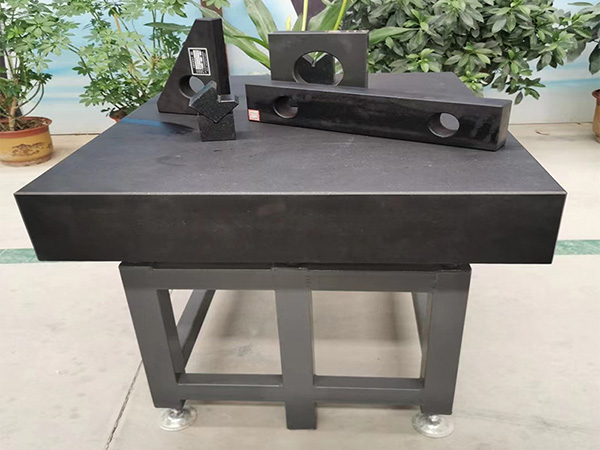
The Role of Granite Platforms in Aerospace Manufacturing
Granite platforms are widely used in aerospace facilities for:
·Precision inspection of aircraft components
·Assembly alignment of structural parts
·Calibration of measurement equipment
·Quality verification during production stages
Their natural rigidity, thermal stability, and resistance to wear make granite platforms particularly suitable for aerospace environments where consistency and repeatability are essential.
Material Quality Requirements for Aerospace Granite Platforms
High-Density Granite Selection
Not all granite is suitable for aerospace use. Aerospace-grade granite platforms require:
·Uniform grain structure
·High compressive strength
·Minimal internal stress
Manufacturers carefully select raw granite blocks during the early stages of production to ensure structural integrity throughout the platform’s service life.
Low Porosity and Structural Homogeneity
Low porosity reduces the risk of moisture absorption, contamination, and surface degradation. Factory-level quality control ensures that granite platforms used in aerospace applications meet strict material consistency requirements before machining begins.
Flatness and Accuracy Standards
Extreme Flatness Tolerances
Aerospace granite platforms must meet extremely tight flatness tolerances. These platforms often serve as the base reference for precision measurement systems, making surface accuracy critical.
During production, manufacturers use controlled machining and fine lapping processes to achieve uniform flatness across the entire granite platform surface.
Long-Term Dimensional Stability
In aerospace environments, platforms must maintain accuracy over extended periods. Granite’s natural resistance to deformation makes it ideal, but only when combined with proper production techniques and stress-relief processes at the factory level.
Environmental Stability Requirements
Thermal Stability
Aerospace facilities often maintain strict temperature control, but granite platforms must still resist minor thermal fluctuations. Granite’s low coefficient of thermal expansion ensures dimensional consistency during inspection and assembly operations.
Vibration Resistance
Vibration can compromise measurement accuracy. The mass and rigidity of granite platforms help dampen external vibrations, supporting high-precision aerospace tasks without additional isolation systems in many cases.
Structural Design and Support Considerations
Proper Support Point Design
Granite platforms rely on carefully engineered support points to maintain flatness. Improper support can introduce internal stress, leading to accuracy loss over time.
Professional manufacturers integrate support design into the production process, ensuring that each granite platform maintains structural balance when installed.
Load Capacity and Distribution
Aerospace components can be heavy and irregularly shaped. Granite platforms must be designed to handle both static and localized loads without distortion, particularly when used for large assemblies or inspection fixtures.
Manufacturing and Production Controls
Precision Machining and Lapping
Granite platform production involves multiple machining and finishing stages. Precision grinding and lapping are essential for achieving the surface quality required by aerospace users.
Factories with mature production systems implement strict process control at each stage to ensure consistent results across bulk orders.
Inspection and Quality Verification
Before delivery, aerospace-grade granite platforms undergo rigorous inspection. Flatness, surface finish, and dimensional accuracy are verified using calibrated instruments to meet industry expectations.
This level of inspection demonstrates a manufacturer’s ability to supply granite platforms reliably at scale.
Cleanliness and Surface Protection Requirements
In aerospace environments, contamination control is critical. Granite platforms must feature smooth, well-finished surfaces that resist particle accumulation.
Manufacturers often apply protective treatments during production and packaging to preserve surface quality during storage and transportation.
Why Factory Capability Matters for Aerospace Supply
Aerospace customers often require multiple granite platforms with identical specifications. This makes factory production capability and batch consistency essential.
Manufacturers with stable production capacity can ensure:
·Uniform quality across multiple platforms
·Consistent lead times
·Reliable long-term supply
These factors are especially important for aerospace programs with strict qualification and documentation requirements.
Conclusion: Meeting Aerospace Expectations with Granite Platforms
The aerospace industry places some of the most demanding requirements on inspection and assembly equipment. A granite platform used in this field must deliver exceptional flatness, stability, and durability under controlled yet demanding conditions.
For users sourcing granite platforms in volume, selecting a manufacturer with advanced production processes, rigorous factory inspection, and experience supplying high-precision equipment is essential. As aerospace technologies continue to evolve, granite platforms will remain a critical foundation for accuracy, safety, and manufacturing excellence.
References
GB/T 7714:Raghavendra N V, Krishnamurthy L. Engineering metrology and measurements[M]. New Delhi: Oxford University Press, 2013.
MLA:Raghavendra, N. V., and L. Krishnamurthy. Engineering metrology and measurements. Vol. 1. No. 2. New Delhi: Oxford University Press, 2013.
APA:Raghavendra, N. V., & Krishnamurthy, L. (2013). Engineering metrology and measurements (Vol. 1, No. 2). New Delhi: Oxford University Press.

-
Stringent Requirements for Granite Platforms in the Aerospace Industry
-
Safe Stacking and Storage Tips for Cast Iron Surface Plates
-
Understanding Welding Table Weight Capacity: Key Information
-
Testing Methods for Machine Tool Castings Materials
-
How to Troubleshoot Measurement Errors on Granite Platforms
-
Applying Vibratory Finishing to Cast Iron Surface Plates
Botou Bozhong Precision Machine Tool Co., Ltd.
Copyright © 2025-2026 https://www.bozhong-weldingtable.com. All Rights Reserved Botou Bozhong Precision Machine Tool Co., Ltd.Copyright